Modeling Thermal Comfort
Overview
-
This project tried to model the thermal comfort in indoors enviroments.
-
The prediction is made in terms of 3 categories:
- warmer,
- colder,
- no change ,
representing the action an HVAC system might make.
-
The data required for modeling was sourced from the ASHRAE Thermal Comfort Database II 1.
-
The dataset contained subjective data as well as instrumental data and some thermal indices.
Data Preprocessing
- The first preprocessing measures I took were the following:
- Removed non-numeric noise data (like ‘Publication’, ‘City’, etc.) and removed °F measurements.
- Replaced all missing data points with the median.
- Removed features like ‘Age’, ‘Height’, etc.
- Encoded all categorical data
In order to get even more useful information out of the data
set I derived some features using the original data.
For example temp_diff is computed using the difference
of the columns Indoor and Outdoor Temperature.
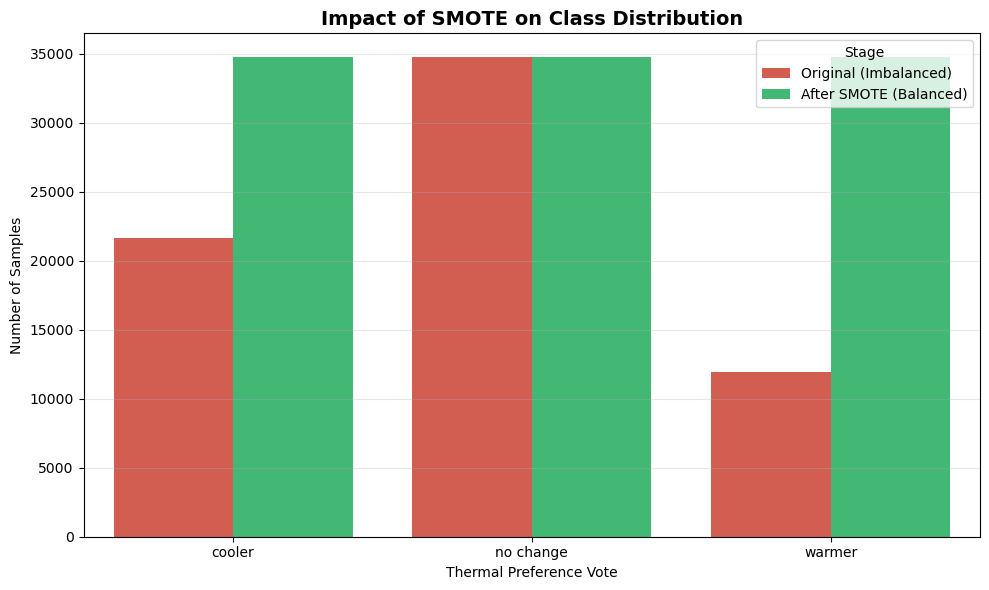
Also, Synthetic Minority Over-sampling Technique (SMOTE) was used in order to enrich the training data with artificially generated data points, while also combating imbalance in the dataset.
Feature selection
For feature selection i used a Random Forest Clasifier
After a few iterations of trying a different numbers of features, I observed that for this model, the more features, the better the results.
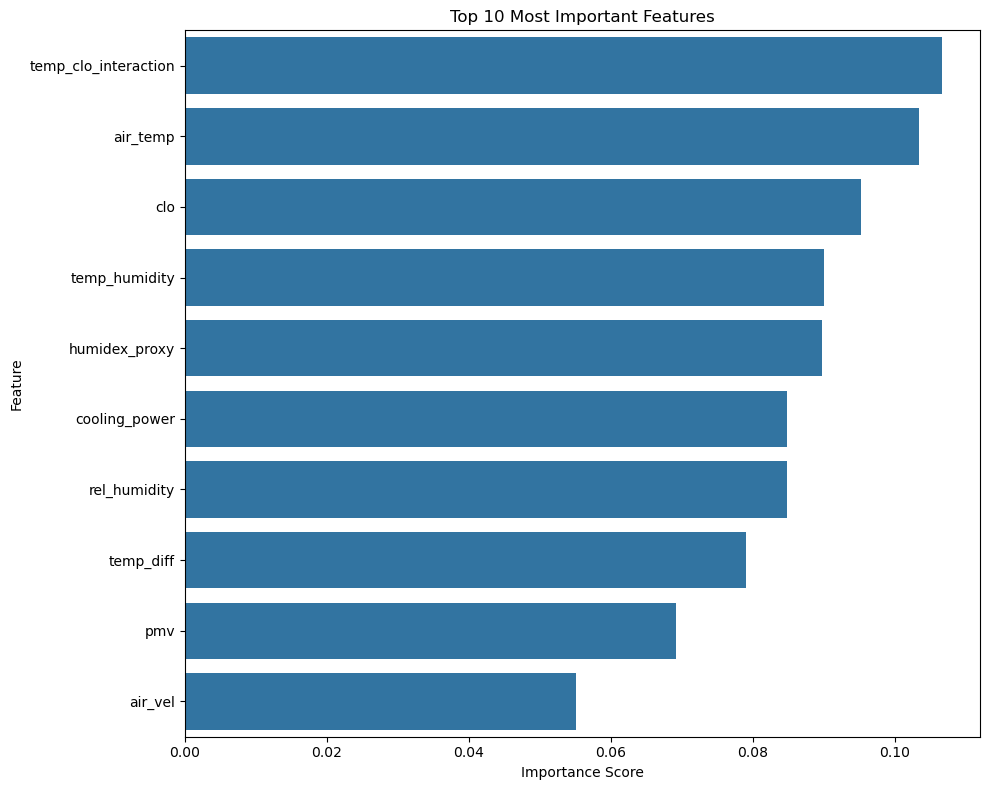
The features were selected using a Random Forest and then the features that contributed to the cumulative importance up to a certain threshold were selected.
In the end, I selected for my model 18 features.
- Some of them are :
- The interaction between Temperature & Clo 2.
- Air temperature in the occupied zone.
- Predicted Mean Vote (PMV)
- The temperature difference between inside & outside.
Predictive Modeling
Here aswell, I used a Random Forest Classifier because its ability to handle non-linear relationships while also being robust against outliers.
The data was split 80/20 before SMOTE was applied. Hyperparameter tuning was used in order to find the best tree depth and leaf size
The optimization objective was to maximize Recall for discomfort classes. The trade off was in a slightly lower accuracy. The logic for choosing this was to steer the model in such a way that it could in theory control a HVAC system.
The final model configuration has 500 trees, with a minimum sample leaf of 4 and a minimum sample split of 10.
Model Evaluation
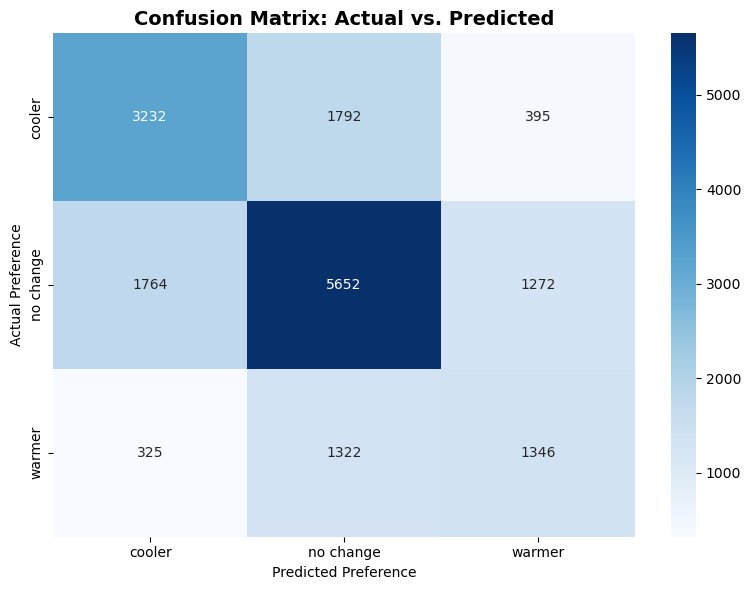
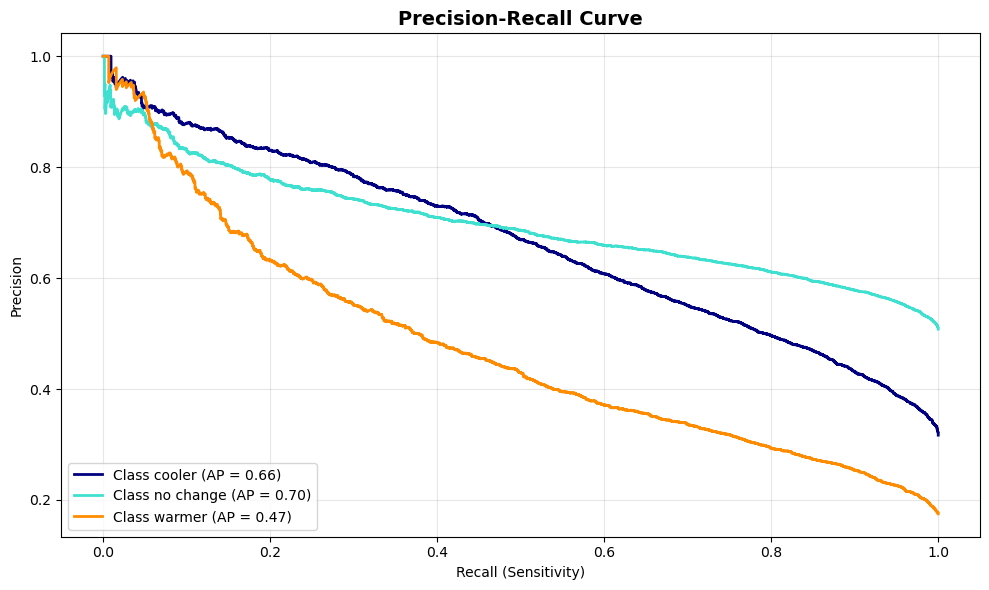
The evaluation was done using a confusion matrix and a precision recall curve aswell as computing the precision,recall and f1-score
Classification Report:
| Category | Precision | Recall | F1-score |
|---|---|---|---|
| Cooler | 0.61 | 0.6 | 0.6 |
| No change | 0.64 | 0.65 | 0.65 |
| Warmer | 0.45 | 0.45 | 0.45 |
- Accuracy was 60%
The model was tuned for Safety (detecting discomfort) rather than pure Precision. Trade-off: We accept a slightly higher false alarm rate (predicting “Warmer” when a person is Neutral) to ensure we don’t freeze occupants.
- The code can be found on my github
T.
-
https://www.sciencedirect.com/science/article/abs/pii/S0360132318303652 ↩︎
-
Intrinsic Clothing Insulation ↩︎